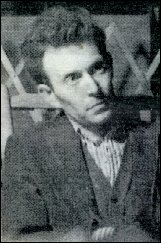
ROSENBERG-Anton, 71, of Woodstock, NY and NYC, died
February 14, 1998.
Beloved husband of Joan for over 40 years; loving father
of Shaun, Jeremy
and Matthew; and father-in-law of Anne, Claudia and Kerry.
Anton was a
close friend to some of his generation's most influential
artists including:
Zoot Sims, Gregory Corso and Mason Hoffenberg. Some will
remember him as
''The Angel of The Subterraneans.'' He will be forever
remembered for his
gentle charm, artistic diversity, wacky inventions,
ascerbic wit and selfless
concern for others. His love will be missed by all.
New York Times February 22, 1998, Sunday
Anton Rosenberg, a Hipster Ideal, Dies at 71
By ROBERT McG. THOMAS Jr.
Anton Rosenberg, a storied sometime artist and
occasional musician
who embodied the Greenwich Village hipster ideal of
1950's cool to such
a laid-back degree and with such determined detachment
that he never amounted
to much of anything, died on Feb. 14 at a hospital near
his home in Woodstock,
N.Y. He was 71 and best known as the model for the
character Julian Alexander
in Jack Kerouac's novel ''The Subterraneans.''
The cause was cancer, his family said.
He was a painter of acknowledged talent, and he played
the piano with such
finesse that he jammed with Charlie Parker, Zoot Sims
and other jazz luminaries
of the day.
But if Mr. Rosenberg never made a name for himself in
either art or music
-- or pushed himself to try -- there was a reason: once
he had been viewed
in his hipster glory, leaning languidly against a car
parked in front of
Fugazzi's bar on the Avenue of the Americas, there was
simply nothing more
he could do to enhance his reputation.
For as Kerouac recognized, Mr. Rosenberg in his 20's, a
thin, unshaven,
quiet and strange young man of such dark good looks that
he was frequently
likened to the French actor Gerard Philipe, was the
epitome of hip, an
extreme esthetic that shunned enthusiasm, scorned
ambition and ridiculed
achievement.
It was Kerouac's friend Allen Ginsberg who discovered
Fugazzi's and its
coterie of hipsters of such bedrock cool that he dubbed
them the subterraneans,
a term Kerouac adopted as the title of his book
published in 1958.
Like other Kerouac works, the book, which was written in
1953, is the most
thinly disguised of fictions, one whose most striking
deception was shifting
its locale from New York to San Francisco to protect the
publisher from
any libel action by the very real Greenwich Village
regulars who populated
its pages under fictitious names. To Kerouac, they were
cynosures of cool.
''They are hip without being slick,'' he wrote. ''They
are intelligent
without being corny, they are intellectual as hell and
know all about Pound
without being pretentious or talking too much about it,
they are very quiet,
they are very Christlike.''
As for Mr. Rosenberg, or Julian Alexander, as he was
called, he was ''the
angel of the
subterraneans,'' a loving man of compelling gentleness,
or as Kerouac put
it: ''Julian Alexander certainly is Christlike.''
By the time he made the Greenwich Village scene, Mr.
Rosenberg, a native
of Brooklyn whose father was a wealthy industrialist,
had served a year
in the Army, studied briefly at the University of North
Carolina and spent
a year in Paris, ostensibly studying art on the G.I.
Bill but in reality
soaking up the Left Bank bohemian atmosphere and
haunting the Cafe Flore
and the Cafe Deux Magots with James Baldwin, Terry
Southern and other incipient
icons of American cool.
Back in New York by 1950, Mr. Rosenberg opened a print
shop on Christopher
Street and plunged into the hip world centered on the
San Remo at Bleecker
and Macdougal Streets.
He lived for a while in the East 11th Street tenement
Ginsberg called Paradise
Valley and had such an instinct for future chic that he
was one of the
first artists to move to an industrial loft in a bleak
neighborhood below
Canal Street years before it became the fashionable
TriBeCa.
In a different life, Mr. Rosenberg might have used the
loft to turn out
masterpieces. But as an ultimate hipster he had other
priorities, which
became apparent one famous Halloween night when the
crew, alerted to a
shipment from the Exotic Plant Company of Laredo, Tex.,
peeled off from
the San Remo and congregated in the loft for an
all-night peyote party
cum jam session.
Drugs, of course, were more than an accouterment of hip.
They were its
very essence. And while marijuana, then an exotic drug
used only by jazz
musicians, was universal among the stoned cool hipsters,
it was heroin
that set the subterraneans apart.
Mr. Rosenberg, who appears as a character in William
Burroughs's book ''Junkie,''
was an addict for most of his adult life, which might
help explain why
he never made a name for himself in art or music or held
a regular job
after his print shop failed in the 1960's.
Fortunately, Mr. Rosenberg, whose survivors include his
wife, Joan, and
a brother, Ross, of Orlando, Fla., had the foresight to
marry a schoolteacher
so enamored of his charming, creative ways that she
cheerfully supported
the family while Mr. Rosenberg continued to paint, play
music, amuse his
friends and family. He also served as a surprisingly
effective role model
for his three sons: Shaun, a Manhattan restaurateur who
owns Orson's on
Second Avenue; Matthew, a computer consultant from the
Bronx, and Jeremy,
of Manhattan, a New York City police detective who
specializes in drug
enforcement.
The "New York Times" Company
229 West 43rd Street
New York, N.Y. 10036-3959
To The Editor:
This letter is written concerning the obituary of Anton
Rosenberg that appeared in the 2/22/98 "Sunday New York
Times." As a long-term friend of Mr. Rosenberg, I found
the subject of the obituary to be without resemblance to
the person I knew. Even more disappointing than factual
inaccuracies was the overbearing, almost snide, attitude
with which it was written. Mr. Rosenberg was the most
amazingly gentle man, generous in spirit, evincing a
play of gentle humor and wit that made him a joy to all
who knew him. He was a devoted and loving husband to his
wife, Joan, and each of them upheld the other in a
completion of true marriage. He was a nurturing father
to his three sons, guiding them with love, wisdom and
humor - a father who could enter their world and see
through their eyes. Anton was an inspired painter and
musician - never seeking fame, which he could well have
obtained except that he was too wise to court such an
ephemeral prize. It was his own integrity, not drugs,
that kept him from bartering his artistic freedom for
the counterfeit coin of public adulation. Anton moved
gracefully through his era. We have been blessed to
share it with him. May his compassion ever unfold.
Anne Spitzer
Beacon, New York
|